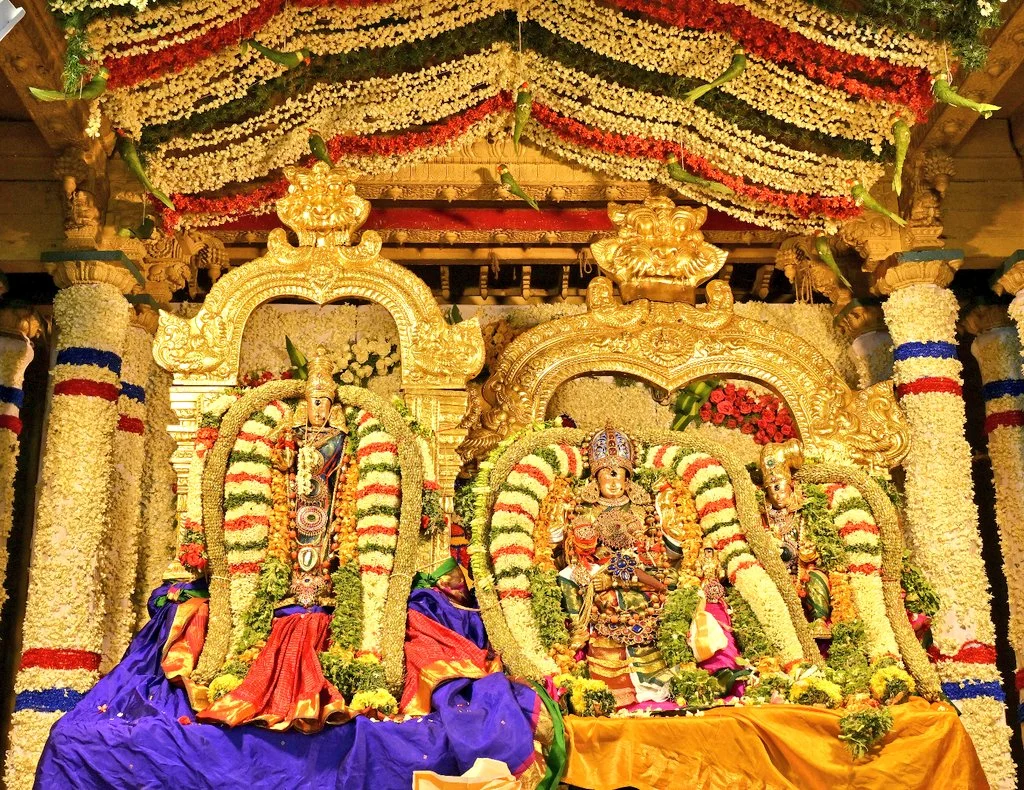
Temple Overview & Shrine Details
| Mulavar (Presiding Deity) | Somasundarakadavul, Sokkalinganadhar, Aalavaai Annall |
|---|---|
| Ambal (Consort) | Meenakshi, Angaiyarkanni |
| Kshethram | Kadambavana Kshethram |
| Direction | Facing East |
| Theertham | Potramaraikulam |
| Sthala Vruksham | Kadambam |
| Paadiyavar | Appar, Gyanasambandar, Sundarar |
| Travel Base | Madurai |
| Nearest Railway Station | Madurai |
| Continent / Region | Pandiya |
| Circle / Taluk | Madurai |
| District | Madurai |
| State | Tamil Nadu |
Location & Accessibility
Madurai is developed around this temple. This temple is the centre place for the whole Madurai. All the important streets in Madurai are around this temple. It is easily approachable either from the railway station or from the Bus Stand.
Architecture
The temple covers the vast area almost 50% of Madurai. The temple which has five entrances covers an area 847 feet (254.1 meters) long and 792 feet (237.6 meters) wide in the North South direction. The temple has four Rajagopurams, there are five towers on top of the sanctum sanctorum of the Lord, three on top of the sanctum sanctorum of the Goddess and two golden towers, all which have been exquisitely designed and sculptured. There are many foreign visitors come to see the splendid work of Architecture. The Innermost ring just outside the temple is "Aadi Veedhi". Next outer layer is "Chitrai Veedhi". The third layer is "Avinimoola Veedhi" and the outermost layer is the "Veli Veedhi". The temple has very big gopurams, big tank etc. The 1000 pillared mandapam is very big and of great importance. Upto 13th Century only Lord Chokkanathar temple was there. In 13th Century, the Pandiya King Kulasekaran built the separate temple here for Lordess Meenakshi. Then after the Pandiya Dynasty built the Killi Mandapam, 1000 pillared Mandapam etc. Before 13th Century only Lord Chokkanadhar prakaram and the Potramarai Kulam was there. The mandapam which is in the eastern entrance of the Amman Sannidhi has been constructed by Thirumalainaicker’ s wife. Thirumalainaicker is one of the Hindu kings who ruled Madurai during 17th century. The eight forms of Goddess Sakthi the consort of Lord Shiva, Karumari, Rowthiri, Vaishnavi, Mahalakshmi, Yangnarubini, Shyamala, Maheswari and Manonmani have been sculptured into the pillars of the mandapam individually.There are drawings depicting the life of Meenakshi Amman on the roof of the mandapam.The drawings depicting incidents of the Thiruvilayadal or miraculous dramas of Lord Shiva belong to the Naicker period.There are paintings depicting the 64 miracles of Lord Shiva, all which were enacted in Madurai. These aesthetic drawings can be seen on the northern wall facing the Potramarai Kulam (the temple tank).
History & Sacred Legend
Originally this place was a forest known as Kadambavanam. One day, a farmer called Dhananjaya while passing through this forest saw Lord Indra (King of Devas) worshipping a Swayambu Lingam under a Kadamba tree. He immediately informed this matter to the King Kulasekara Pandya. The King cleared the forest and built a temple around the lingam and the tree. On the day of naming the city, Lord Shiva appeared before them and the drops of nectar from Lord Shiva's hair fell on the city. So the city was named Madurai - mathuram means 'Sweetness'. Madurai is one five sabhas for the Dancing diety of Lord Shiva called 'Velliyambalam'. According to legend, the linga here is Suyambu discovered by the king of Devas Indra at Kadambavanam, was later enshrined by him in Madurai. The fact that the Lord is seen on the vehicle of Indra in this temple is said to be proof for this. Many historical evidences of the temple have been found dating back from early A.D. The temple was almost completely destroyed in the year 1310 following the invasion of the Islamic conqueror Malikkapur and the invaders destroyed most of the ancient sculptures of the temple. Thirugnanasambandar the Hindu Saint has mentioned the temple in his songs which go back to early 7th century. The Lord has been described as Alavai Iraivan in his songs. The temple was restored to its pristine glory in the late 14th century when the Hindu Kings came back to power in Madurai. This can also be termed as a new beginning of a new era in the history of the temple, when it was almost rebuilt. The King Thirumalai Naicker played an important role in the construction of the new form of the temple according to records.
Festivals & Celebrations
Throughout the year there will be festival in this temple. 64 Thiruvilaiyadal Puranam will be narated on each festival. Amoung the festivals Chitirai Festival is of great importance.