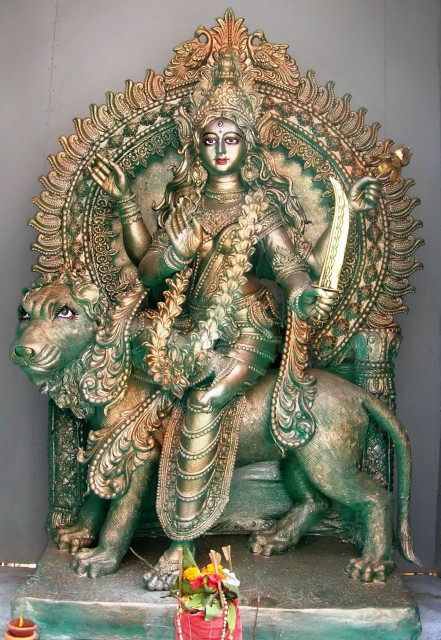
About Katyayani
Mother Durga is worshipped in her sixth form under the name Katyayani. The sage Kata had a son, Katya, and it was in the lineage of the sage Katyayana, descended from him, that the Goddess is said to have been born as a daughter — after the sage performed many years of severe penance to receive Durga as his own child. In fulfilment of his wish, the Mother Goddess who would later slay the demon Mahishasura was born in his household, and became renowned by the name Katyayani. She wears a crescent moon on her forehead, adorned with various ornaments, and has four arms — with her right hands displaying gestures of blessing and fearlessness, while in her left hands she holds a lotus flower and a sword. Her vehicle is the lion.
When the demon Mahishasura once invaded the realm of the gods, driving them from the heavens and tormenting the three worlds, it was revealed — through Brahma's grace after the demon's own severe penance — that he could be slain only by the hand of a woman. In response, Brahma, Vishnu, Shiva, and all the gods — Indra, Yama, Varuna and others — combined their divine energies, each contributing a portion of their own power, along with their respective weapons, to form the Goddess. As it was the sage Katyayana who first worshipped her, she came to be called Katyayani, and after she slew Mahishasura, she also received the name Mahishasuramardini — the Slayer of Mahishasura. The battle unfolded from Ashwin Krishna Chaturdashi through the bright fortnight — Saptami, Ashtami and Navami — culminating on the tenth day, Dashami, when the demon was finally vanquished, revealing the full glory of the Goddess's divine power. In eastern India, particularly in Bengal, this form of the Goddess is celebrated with great renown as part of Durga Puja.
Her form is majestic and radiant. According to tradition, the Gopis of Vraja worshipped Katyayani Devi in order to attain Lord Krishna as their beloved. The sixth day of Navratri is dedicated to her, and it is from this day that the festivities of Durga Puja traditionally begin in Bengal, celebrated with great enthusiasm. Her worship is said to grant the fulfilment of dharma, artha, kama and moksha — righteousness, prosperity, desire and liberation — while dispelling the sins of birth and death.