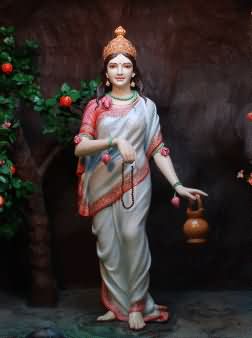
About Brahmacharini
The second form of Goddess Durga is known as Brahmacharini — 'she who practises austerity' — for in this form the Goddess performs rigorous penance, embodying intense spiritual discipline. She bears a crescent moon and various ornaments; in her right hand she holds a rosary (japa mala) for chanting, and in her left a kamandalu (water pot). She has three eyes and radiates serenity.
Born as the daughter of the Himalaya, she resolved with unwavering determination to attain Lord Shiva as her husband. Following this resolve, the Goddess began visiting and serving Shiva daily — yet her devotion had no visible effect on him, for he remained deep in meditation. Even when the gods sent Kamadeva, the god of love, to break his concentration, Shiva remained unmoved and, in his anger, reduced Kamadeva to ashes. Undeterred, and on the counsel of the sage Narada, the Goddess resolved to undertake severe penance to win Shiva as her husband. Because of the extreme rigour of this penance she came to be called Brahmacharini. For thousands of years she fasted and practised austerity — in the first year subsisting only on fruit, in the second only on leaves, and in the third she gave up even leaves entirely, for which she is also known as Aparna. Her penance was so intense that it shook the three worlds, and even Brahma himself appeared and declared, 'No one has ever performed such austerity before — your wish shall be granted.'
After the loss of Sati, Lord Shiva had withdrawn to the Himalayas in constant meditation, detached from the world. Eventually, moved by the Goddess's severe penance as Brahmacharini, Shiva relented and agreed to marry her. This form of Durga is believed to grant her devotees infinite rewards, especially in matters of tenacity, renunciation, restraint and self-discipline. The second day of Navratri is dedicated to Brahmacharini Devi.