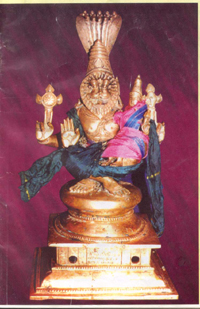
Nrusimha (in Sanskrit), popularly called by devotees as "Narasimha", denotes the divine form of half man and half lion. The Asura King Hiranyakashibu on the advice of his guru Shukracharya, undertook severe penance on Lord Bramha and when the God appeared before him, he requested boons in the hope that he would not die: 1) No human or animal can kill him. 2) Death should not occur in his palace or outside. 3) Death should not occur during day time or night.
When granted the boon, he thought he was immortal and tortured saints. Meanwhile, his wife gave birth to Prahlada, who heard the Bhagavatha from Naradha Maharishi in the pre-natal stage and became deeply devoted to Narayana. Prahlada would always chant 'Om Namo Bhagavathe Vasudevaya'.
Hiranyakashibu tried several horrendous methods to convert or destroy his son, but Prahlada's strong devotion kept him unscathed. One day, Hiranyakashibu asked Prahlada to show him where his God was. Prahlada proclaimed that Lord Narayana is everywhere, present in every pillar and tiny particle. When Hiranyakashibu struck a pillar, the Lord emerged as Narasimha—honouring every boon—caught hold of Hiranya, sat on the doorstep at twilight (Sandhya Kala), and vanquished the demon king.
Fulfillment of Boons
| Boon Given to Hiranyakashibu | Avatar Fulfillment |
|---|---|
| No human or animal can kill him. | Took the form of half lion and half man (Lion's head & claws, human body). |
| Death should not occur inside or outside his palace. | He was slain right on the doorstep of the palace. |
| Death should not occur during day or night. | The Lord chose Sandhya Kala (dusk), when day and night meet. |
Narasimha Shalagrama-Shilas
In addition to the Vigraha (Deity) form, Lord Narasimha also appears as the self-manifested Shalagrama-Shila. There are twenty-four varieties of Narasimha-salagrama:
- (1) Laksmi-narasimha
- (4) Yogananda-narasimha
- (5) Bala-narasimha
- (6) Vidyujjihva-narasimha
- (7) Vibhisana-narasimha
- (8) Adhomukha-narasimha
- (9) Patala-narasimha
- (10) Sarvati-mukha-narasimha
- (11) Raksasa-narasimha
- (12) Vidurarana narasimha
- (13) Kukushi narasimha
- (14) Bhitti-narasimha
- (15) Vijaya-narasimha
- (16) Kapila narasimha
- (17) Jvala-narasimha
- (20) Maha-jvala-narasimha
- (21) Suddha-narasimha
- (22) Buddha-chakra-narasimha
- (23) Damsthra-karala-narasimha
- (24) Vakra-damshtra-narasimha
Specific Descriptions:
1) Narasimha-salagrama: Has an elongated mouth, tawny hued, a longish cakra and a big belly. Suitable for worship by ascetics.
2) Laksmi-narasimha-salagrama: Has a cakra on its left side, is black in color with spots. Grants worldly prosperity (bhukti) and emancipation (mukti).
3) Maha-jvala-nrsimha-salagrama: Thick in shape, blue-black in color with a gaping aperture. Fit for worship by mendicants (mahamuni).
4) Kapila-narasimha-salagrama: Has a large chakra at the tusk location, tawny color with vanamala mark. Worshipped by celibates (brahmachari-s).
Moola Mantra of Nrusimhaswamy
