the Ultimate Web on Indian Gods & Temples
by Padmani,
|
|
|
the Ultimate Web on Indian Gods & Temples by Padmani, |


|
KOYILNET |
|
Abodes of Vishnu |
Matsya Avthar
 |
In MASTYA Avatar, Lord Vishnu incarnates himself as a fish in this world. In the earliest yuga (era) of Sata-yuga, a king named Manu was performing severe penance for thousands of years. One day as he was performing ablutions with river water, a small fish came into his hands and just as he was about to throw the fish back into the river, the fish requested the king to save its life. Heeding its request, the king put the fish into a jar of water but the fish started growing and the jar was not big enough for it. Then the king threw it into the river, but it soon it outgrew the river and the king then threw it into Ganges and then into the ocean. The king realised that it was Lord Vishnu himself and then the lord made an appearance and made a special request to the king, that as the world would come to an end by a huge flood in next seven days, to build a huge boat and take the seven sages (hermits), seeds of all plants, one animal of each type and also told him that Lord would appear as a fish to propel the boat to Mt Himavan for surviving the flood to the next yuga(eon). While Brahma was falling asleep, at the end of the KALPA (one day of Brahma - equal to 4320 million years), the asura HAYAGRIVA wanted to take advantage of the circumstances to steal from him the Vedas. Before the latest creation of the present universe, the four Vedas (the holy books from the mouth of the Supreme-Deity) remained drowned in the waters. It was necessary to get hold of them to instruct Brahma about the work of creation.Vishnu was therefore appointed to bring up the Vedas from the deep. But Lord Vishnu caught the asura in the act, and to retrieve the Vedas, took the form of a fish (Matsya), descended into the waters and brought up the sacred books. |
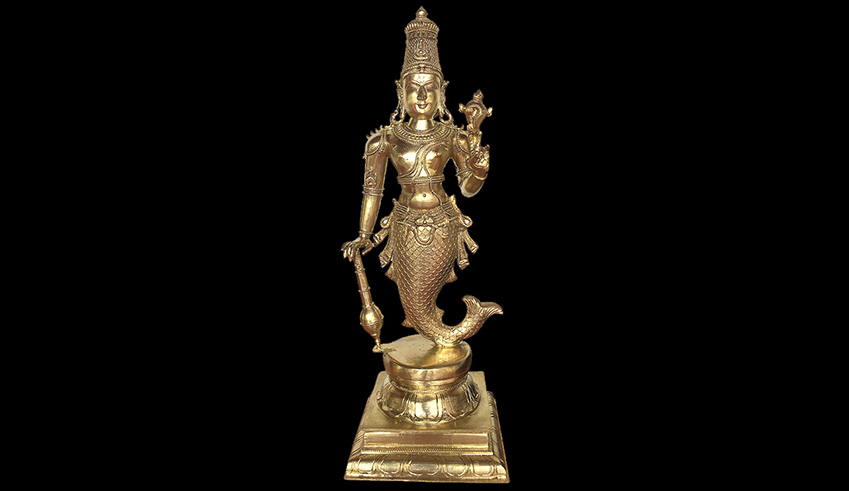
| True to his word, after seven days the Lord appeared and the king tied the boat to the fish by using the royal serpent Vasuki and the fish took all of them to Mt Himavan and kept them there till the flood was over and in the new era, the king started procreation a for the new era. The universe was going to be submerged into waters so Vishnu became Matsya. As Matsya, Vishnu protected Vedas, Manu, Shatarupa, the Saptarishis, and one set of other living beings to preserve them during dissolution. He kept cruising the waters while protecting Manu and others for the entire span of pralaya (cosmic dissolution). Eventually when pralaya was over he handed down the Vedas to Brahma and imparted to Manu the knowledge of dharma needed to rule the next world as a righteous king. That knowledge is preserved in Matsya Purana. The avatar of Srinivasa Vishnu, Matsya, may be expressed as a giant fish, often golden in color with a horn on its head, or as half human and half fish, with the torso of Vishnu connected to the rear half of a fish.The Shatapatha Brahmana contains the earliest description of Matsya, in which Matsya is not linked to any particular deity. Lord Vishnu is always portrayed as wearing a big crown on his head and having four arms, in which his two upper arms sport Shankha (conch) and Chakra (disc).Both of his lower hands are displayed in the Varada (boon-giving) pose, with the other one artfully perched on his thigh. Positions are changed. |