

the Ultimate Web on Indian Gods & Temples
by Padmani,
|
|
|
the Ultimate Web on Indian Gods & Temples by Padmani, |


| Koyilnet | Abodes of Vishnu |
|
39. Arulmigu Thamarainayaki sameda Thamarayal Keelvan Koil - Thiruparthanpalli
|
Location
| This temple is in the village of Thiru Nangur and called as Thiruppaarthanpalli or Thamaraiyaal Kelvan Perumal Temple. It's about 5 miles (8 kms) away from Sirkazhi. It is one among the eleven divyadesams of Thirunangur Tirupathis. The place is 8 km far from Sirkali. Buses are available only at specific hours. The visitor may reach Sirkazhi – Annankoil. The temple is 2 km from here. There are buses from Mayavaram / Sirkazhi that goes past Thiru Nangur. Direct special buses are available only on special occasions. If you are going in car it is 20 kms from Mayavaram and 8 kms from Sirkazhi. |
History
|
The legends of all the eleven temples of Thirunangur are closely associated with each other. As per legend, the Hindu god Shiva started dancing in fury at this place after the death of his consort Uma due to the yagna (sacrifice) of Daksha. Each time his lock of hair touched the ground; there were eleven other forms of Shiva who appeared. The celestial deities were worried that if the dance continues, it would result in decimation of entire creations. They prayed to Vishnu for help, who appeared at this place. On seeing Vishnu, Shiva's anger was reduced and he requested Vishnu to appear in eleven forms like he did. On his request, Vishnu appeared in eleven different forms at Thirunangur. Arimeya Vinnagaram literally translates to the place where Hari (another name of Vishnu) resides. The eleven places where Vishnu appeared are believed to be where the eleven temples in Thirunangur are located. Padmapurana details the legend associated with the temple. As per Hindu legend, Arjuna, one of the five Pandavas from the epic Mahabharata reached this place on a pilgrimage. He was thirsty and sought water from sage Agastya who was doing penance. There was no water with the sage and all places around. Agastya realised that it was the trick of god Krishna, who was the Lord of Arjuna. He advised Arjuna to pray Krishna, who did accordingly. Krishna was pleased with the prayer of Arjuna and offered him a sword. Arjuna dug the land with the sword which resulted in a gush of water resulting in the Katka Pushkarani, the temple tank. Arjuna is depicted in the temple sporting a sword, following the legend. Krishna also appeared to Arjuna as Parthasarathy and initiated his knowledge to understand who he actually was. Since Parthasarathy initiated education here for Arjuna, the place is called Paarthanpalli (Parthan + Palli, meaning school of Arjuna). It is believed that several sages like Agastya, Bharadwaja, Gautama and Varuna performed penance at this place. Varuna, the Rain God, once stole the wife of Bhragaspathi, the Devaguru and was caught by the Brahma Hathi Dhosham. He got relieved of it by praying to Lord here. It is said that the meaning of the Sharma sloga, the Gota slogam (“Sharva Dharman….”) was got at this place only. |
Architecture
|
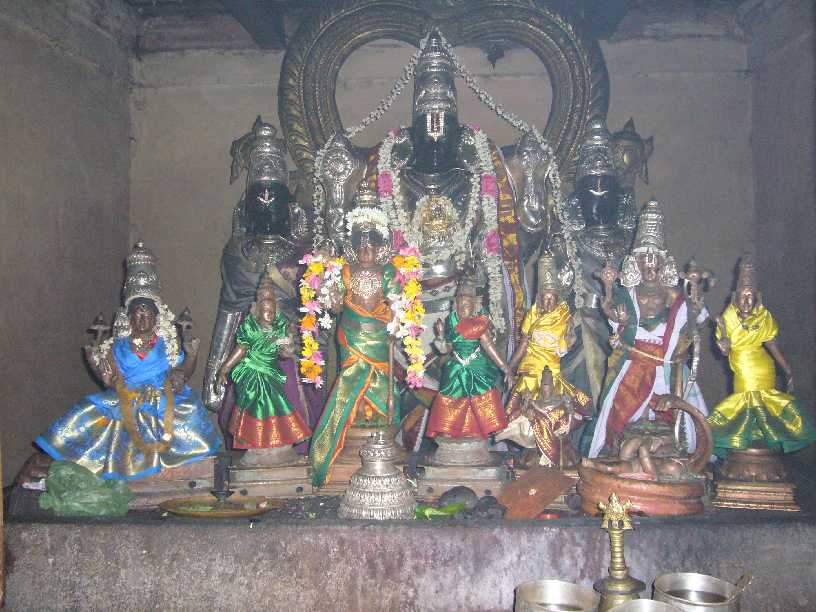
The temple complex has a single prakaram (closed precincts of a temple) and separate shrines for Tamaraiyan Kelvan Perumal facing west, Shenbagavalli Thayar facing east. The vimana of the temple is called Narayana Vimanam and water body associated with the temple is called Katka Theertham. The festival images of Tamaraiyan Kalvan, Krishna and Rama, are stored in the shrine of Tamaraiyan Kelvan. This is the only temple where the images of Rama and Krishna are housed in the same shrine. The main gateway tower, the Rajagopuram faces west and the temple is surrounded by walls. The temple tank is located in the southern side outside the temple complex. There is a separate hall in the temple complex that houses the chariot and festival chariots. The festival deity has four consorts namely, Sridevi, Bhudevi, Neeladevi and Jambavathy. Following the legend of sage Agasthiyar, a separate shrine of Agasthiyar was built during the consecration of the temple in May 2015. The Moolavar is Thamaraiyaal Kelvan also called Parthasarathy, Lakshmi Rangar in a standing posture facing east with the Thayar Thamarai Nayaki. There is an Utsava Moorthi of Ramar called Kolavalli Raman with Sankhu, Chakra, Ghadhai, bow and arrow. Theertham of this temple are Sankara Saras Pushkarani, Ganga theertham. As the Ekadasa Rudhiran got Dharsan here, the Pushkarani is known as Shankara Saras where Shankara means Lord Shiva and as an honour to Ganges which is in the top of Lord Shiva’s head, it is also known as Ganga Theertham. |
Festival
|
The Tirumangaialwar Mangalasasana utsavam in the month of Thai (after the new moon night) witnesses Garudasevai - a spectacular event in which festival images of Perumaal from the 11 (Tirunaangur) Divya Desam shrines in the area are brought on Garuda mounts to Tirunangur. An image of Tirumangai Alwar is brought to Tirunaangur on a Hamsa Vahanam (from Tirunagari) and the his paasurams (verses) dedicated to each of these 11 Divya Desams are recited. The image of Tirumangaialwar circumambulates each of these deities, and at the conclusion of the festival, the images are returned to their temples. Prior to this, the image of Tirumangaialwar and his consort are taken in a palanquin to each of the 11 Tirunangur Divya Desams, (trampling) through the paddy fields in the area, and the paasurams dedicated to each of the 11 Divya Desams are chanted in the respective shrines. The Ekadasa Garuda Sevai is the most important festivals in this area, and it draws thousands of visitors. |
Timings:8.00 am to 10.00 am, 5.00 pm to 7.00 pm