

the Ultimate Web on Indian Gods & Temples
by Padmani,
|
|
|
the Ultimate Web on Indian Gods & Temples by Padmani, |


| Koyilnet | Abodes of Vishnu |
|
35. Arulmigu Kadalmagal Nachiyar sameda Madava Perumal Koil - Thiru Devanoorkugai
|
Location
| This temple is located near the village of Thiru Nangur and called as Thiruthevanartthogai or Madhava Perumal Temple. It's about 5 miles (8 kms) away from Sirkazhi. It is one among the eleven divyadesams of Thirunangur Tirupathis. The temple is located at the place Keezha Salai which is 2 kms north of Thirunangur which is 8 kms South West of Sirkazhi Town. Thirunangur is 8 km far from Sirkali. Buses are available only at specific hours. This Temple is located about 3 kms North East of Anna Koil and 2 kms from Purushottamar koil. There are buses from Mayavaram / Sirkazhi that goes past Thiru Nangur. Direct special buses are available only on special occasions. If you are going in car it is 20 kms from Mayavaram and 8 kms from Sirkazhi. |
History
|
The legends of all the eleven temples of Thirunangur are closely associated with each other. As per legend, the Hindu god Shiva started dancing in fury at this place after the death of his consort Uma due to the yagna (sacrifice) of Daksha. Each time his lock of hair touched the ground; there were eleven other forms of Shiva who appeared. The celestial deities were worried that if the dance continues, it would result in decimation of entire creations. They prayed to Vishnu for help, who appeared at this place. On seeing Vishnu, Shiva's anger was reduced and he requested Vishnu to appear in eleven forms like he did. On his request, Vishnu appeared in eleven different forms at Thirunangur. Arimeya Vinnagaram literally translates to the place where Hari (another name of Vishnu) resides. The eleven places where Vishnu appeared are believed to be where the eleven temples in Thirunangur are located. It's been said that Lord Narayana married Godess Lakshmi Devi who emerged out of the Thiruppaarkadal at this place. A congregation of Devas assembled at this shrine and worshipped Lord Vishnu who gave Dharshan in marriage posture to them. Hence it is called Devanaar Thogai (congregation of Devas). It is situated on the South bank of river Manni. It is believed that, after having Dharsan of this perumal, unmarried persons get married and childless couples got the boon of child birth. Purana says Vasishta Muni meditated and worshipped Lord Madhava Perumal in this place, who blessed him. As this place was graced by the Celestial persons, the shadow of the Vimaanam falls within the range of the Vimaanam (temple tower) itself. The term Madhavan, Emperumaan are common for both Lord Shiva and Lord Vishnu. Henceforth to represent this unison, though the temple is a Vishnu temple, there is a burial ground the favourite place of Lord Shiva in the backyard of this temple. |
Architecture
|
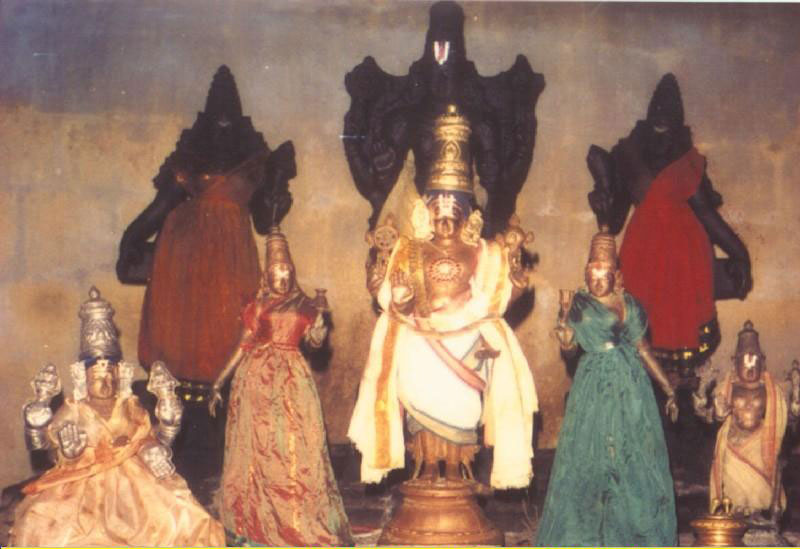
The temple has a three-tiered Rajagopuram and all the shrines are enclosed in concentric rectangular walls. The presiding deity, Deivanayagan, in standing posture faces east. The images of the consort, Kadalmagal Nachiyar and the festival deities, Madhava Perumal and Madhava Nayagi are housed in the same shrine. Main Deity is known as Deivanayaka Perumal with Sridevi and Bhoodevi in standing posture, facing east. Thayar is known as Deivanayaka Thayar, and she is seen in separate sanctum as you go around the prakaram. Pushkarani is Sopana Pushkarani in front of the temple. Urchavar Idols of Madhava Perumal, Thirumagal, Bhoodevi, Madhava Nayaki, Thayagaperar, Teertha perar, and Santhana Krishnan can be seen in the temple. There is separate sanctum for Nammazhwar and Udayavar. The temple is a small one with a single prakaram having Artha Mandapam. The vimanam is built in two tiers in such a way that the shadow of the vimanam falls on the vimanam itself. This is considered as a good Marriage Parihara sthalam since the Perumal is giving Dharshan in the marriage posture. As the Lord is in the Marriage pose, the Vimaanam and Pushkarani are named Shobana Vimaanam and Shobana Pushkarani respectively. And in order of homage to the celestial persons, the pushkarani also named as Devasaba Pushkarani. |
Festival
|
The Tirumangaialwar Mangalasasana utsavam in the month of Thai (after the new moon night) witnesses Garudasevai - a spectacular event in which festival images of Perumaal from the 11 (Tirunaangur) Divya Desam shrines in the area are brought on Garuda mounts to Tirunangur. An image of Tirumangai Alwar is brought to Tirunaangur on a Hamsa Vahanam (from Tirunagari) and the his paasurams (verses) dedicated to each of these 11 Divya Desams are recited. The image of Tirumangaialwar circumambulates each of these deities, and at the conclusion of the festival, the images are returned to their temples. Prior to this, the image of Tirumangaialwar and his consort are taken in a palanquin to each of the 11 Tirunangur Divya Desams, (trampling) through the paddy fields in the area, and the paasurams dedicated to each of the 11 Divya Desams are chanted in the respective shrines. The Ekadasa Garuda Sevai is the most important festivals in this area, and it draws thousands of visitors. |
Timings: 8.00 am to 10.00 am, 5.00 pm to 7.00 pm