

the Ultimate Web on Indian Gods & Temples
by Padmani,
|
|
|
the Ultimate Web on Indian Gods & Temples by Padmani, |


| Koyilnet | Abodes of Vishnu |
|
32.Arulmigu Pundareegavalli Thayar sameda Narayanan Koil Thirumanimaada Koil
|
Location
| This temple is in the village of Thiru Nangur and called as Thirumanimadam or Narayanan Perumal Temple. It's about 5 miles (8 kms) away from Sirkazhi. It is one among the eleven divyadesams of Thirunangur Tirupathis. The place is 8 km far from Sirkali. Buses are available only at specific hours. The visitor may reach Sirkazhi – Annankoil. The temple is 2 km from here. There are buses from Mayavaram / Sirkazhi that goes past Thiru Nangur. Direct special buses are available only on special occasions. If you are going in car it is 20 kms from Mayavaram and 8 kms from Sirkazhi. |
History
|
The legends of all the eleven temples of Thirunangur are closely associated with each other. As per legend, the Hindu god Shiva started dancing in fury at this place after the death of his consort Uma due to the yagna (sacrifice) of Daksha. Each time his lock of hair touched the ground; there were eleven other forms of Shiva who appeared. The celestial deities were worried that if the dance continues, it would result in decimation of entire creations. They prayed to Vishnu for help, who appeared at this place. On seeing Vishnu, Shiva's anger was reduced and he requested Vishnu to appear in eleven forms like he did. On his request, Vishnu appeared in eleven different forms at Thirunangur. Arimeya Vinnagaram literally translates to the place where Hari (another name of Vishnu) resides. The eleven places where Vishnu appeared are believed to be where the eleven temples in Thirunangur are located. Nara Narayanar is the form of Lord who is a student as well as a teacher simultaneously, teaching Gnana to himself. Lord Naarayanan of Manimaada Kovil stands as Nara Narayana of Bhadhrinath who taught Gnana to himself. Nanda Vilakku means the lamp which gives light non-stop and usually it is kept in a beautiful Maadam, a structure used for placing lamps. This place is known as Mani Maada Kovil with the temple as the Maadam and Perumal as the Nanda Vilakku spreading the light of Pranava Gnanam to the world. Indra worshipped Lord Vishnu here and got the Dharsan of Lord Narayana. It is also believed that Lord Badri Narayanar came down to bless Sage Matangar. Prathyaksham is given for Lord Indra and Ekadasa Rudhrars. |
Architecture
|
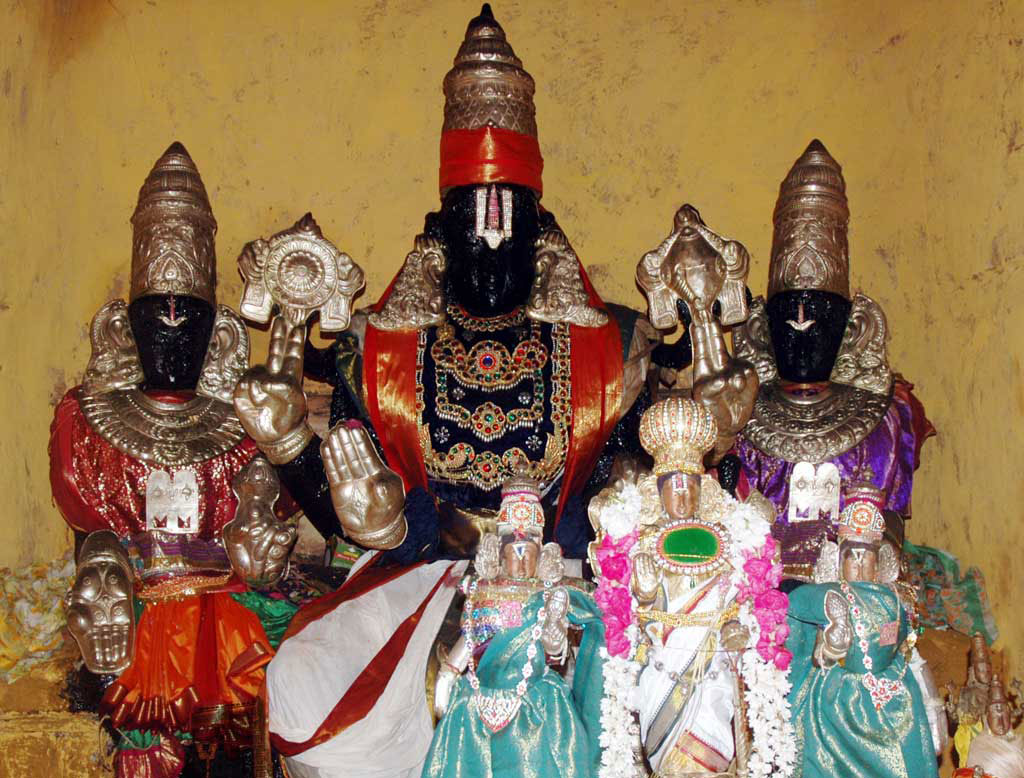
The temple has a five-tiered Rajagopuram (gateway tower) and all the shrines of the temple are enshrined in a granite wall. The central shrine is built on an elevated structure and is reached by a flight of steps. Inscriptions from 10th century Chola and Nayakkar periods are seen in the temple. There is a hall adjacent to the right of the Rajagopuram, where the festival image of the fourteen temples in Thirunangur and its surrounds are housed during the Thirumangai Azhwar Utsavam. The shrine of the consort of Narayana Perumal is located in the second precinct around the sanctum. The image of the presiding deity is sported in the sanctum in standing posture facing east. The temple tank is located opposite to the gopuram. The Moolavar is Sri Badri Narayanan also called Nanda Vilakku Nara Narayanan, in a seated posture facing east and the Thayar Sri Pundareeka Valli Thaayar. The Utsavar is Narayanan, also Known as Alatharku Ariyan. There are shrines for Thirumangai Azhwar and Thirukoshtiyur Nambi. Theertham of this temple are Indra Pushkarini and Rudhira Pushkarani, as Indra and the Rudhira got the Lord’s Dharshan. Vimanam is Pranava Vimanam. As the Lord here vibrates all his powers as Pranava, non-stop like a Nanda Vilakku, the Vimaanam here is Pranava Vimaanam. |
Festival
|
The Tirumangaialwar Mangalasasana utsavam in the month of Thai (after the new moon night) witnesses Garudasevai - a spectacular event in which festival images of Perumaal from the 11 (Tirunaangur) Divya Desam shrines in the area are brought on Garuda mounts to Tirunangur. An image of Tirumangai Alwar is brought to Tirunaangur on a Hamsa Vahanam (from Tirunagari) and the his paasurams (verses) dedicated to each of these 11 Divya Desams are recited. The image of Tirumangaialwar circumambulates each of these deities, and at the conclusion of the festival, the images are returned to their temples. Prior to this, the image of Tirumangaialwar and his consort are taken in a palanquin to each of the 11 Tirunangur Divya Desams, (trampling) through the paddy fields in the area, and the paasurams dedicated to each of the 11 Divya Desams are chanted in the respective shrines. The Ekadasa Garuda Sevai is the most important festivals in this area, and it draws thousands of visitors. |
Timings: 8.00 am to 10.00 am, 5.00 pm to 7.00 pm