

the Ultimate Web on Indian Gods & Temples
by Padmani,
|
|
|
the Ultimate Web on Indian Gods & Temples by Padmani, |


| Koyilnet | Abodes of Vishnu |
|
19. Arulmigu Sowndaryavalli Thayar sameda Sowndaryarajan Koil - Thirunagai (Naagappattinam)
|
Location
| The temple is located at about 3 kms South of New Bus Stand. Extensive network of roads connect it to Chennai, Madurai, Tiruchirappalli, Pondicherry, Thanjavur and all other major cities. Nagapattinam is located at a distance of about 330 kms from Chennai by Road. The temple is walking distance from the Nagapattinam Railway Station. Nagapattinam railway junction connects Thiruvarur in the west, Nagore in the north, Velankanni in the south and Karaikal in the east. There is a daily express train to Chennai via Mayiladuthurai and Ernakulam via Coimbatore and it connects all major cities. The nearest Airport is Tiruchirapalli Airport, located 145 km (90 miles) away from the town. |
History
|
The tributary of river Cauvery, Odambokki, passes close to the temple and the river is also called Virutha Kaveri. This leads to one of the names of presiding deity, "Kaveri Thuraivan". The present day Nagapattinam is believed to have been a forest, historically named Sundararinyam. It is believed that two eunuchs, Kandan and Sukandan, attained physical fitness after having a holy dip in Sara Pushkarani, the temple tank. The Hindu god of creation, Brahma, started worshiping Vishnu at this place. Vishnu is believed to have appeared on the auspicious day of Masi Maham on the banks of Sarapushkarani. On account of the glow emanating from Masi Maham, Vishnu at this place was called "Azhagiyan". Since he had a glittering skin, he was called "Soundara Rajan", meaning the most beautiful and his consort was called Soundaravalli. Since the king of Nagars (snakes),Adisesha worshipped Vishnu at this place, the place was called Nagar Pattinam, the place of Nagars. Another legend has that Druva, Son of King Uthanapadha underwent penance to get possession of the entire world under his regime and he prayed to Lord Vishnu. He followed strict austerities in this sacred land. The compassionate Lord appeared before Druva in one of his most beautiful form on his celestial vehicle Garuda. After seeing the most attractive form of Lord, Druva completely forgot his longing to rule the entire world and requested Lord to provide Salvation. The fame of this temple is distinct and dates back across each of the 4 Yugams. In Kretha Yugam, the king of Nagas (Serpent Lord) undertook penance here. Pleased with this, Lord Vishnu agreed to accept Adisesha as the one on whom he would rest ‘always’. Since the Serpent Lord bagged this big gift from the Lord, this place has come to be called ‘Naagar’ Pattinam. It was here that Bhooma Devi in Thretha Yugam, and Markandeya Rishi, in Dwapara Yugam, Saleesa Chola during Kali Yuga undertook penance. It is believed that Naga Raja performed Kanniga Dhanam at this kshetram. |
Architecture
|
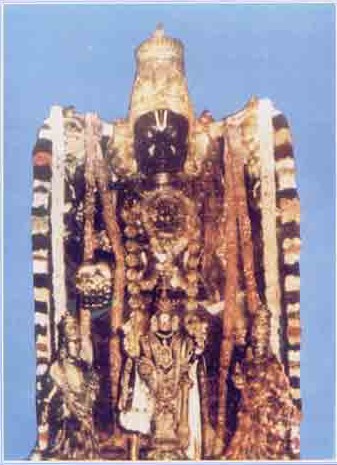
The temple is located in Nagapattinam, a town in the South Indian state of Tamilnadu. The main entrance of the temple faces the East and, at the entrance of the temple, there is a four pillared open hall. The temple has a 90 ft. (27 m) tall Rajagopuram (temple tower) and is enclosed by rectangular walls around it. There is a smaller temple tower on the western side. The walls of the temple are surrounded by large streets, through which the temple chariot passes during festivals. The Southern street accommodates the station of the temple chariot and Sarapushkarani, the temple tank. A rare image of Narasimha with eight hands, one blessing Prahalada, another showing Abhaya Mudra and the others involved in the killing of the demon, Hiranyakashipu, is present in the temple. There is a four-pillared hall in front of the shrine of Soundaravalli shrine that has beautiful architectural treatment. The hall has the images of the architects who designed it. The Nayaka hall is built like a chariot with wheels outside it. The hall which has entrance to the temple has two eight foot sculptures of the guardian deities Sumba and Nigumba. Vishnu is worshiped as Soundararaja Perumal and his consort Lakshmi as Soundaravalli. The temple is believed to be of significant antiquity and is believed to be initiated by the Medieval Cholas of the late 8th century AD, with later contributions at different times from Thanjavur Nayaks. The temple has two inscriptions dating from the Chola period. The complex contains all the shrines and water bodies associated with it. Since the presiding deity and Goddess shines with a bright face here, they are called as Soundararaja Perumal and Soundaravalli, ‘Soundaram’ refers to ‘most beautiful’ in Tamil Language. The Vimanam (temple tower) of this temple is called Soundarya Vimanam. Utsavar is Soundararaja Perumal and Moolavar is Neelamegha Perumal with his consort Goddess Soundaravalli Thayar in standing posture facing east. The lord Neelamegha perumal with Gada is in a majestic standing posture blessing devotees. The idol is more than 5 feet tall. Along with this there is a small Krishna idol in a cradle is given to devotees to rock as mukundashtakam is chanted for realization of our dreams and also to beget progeny. Soundarya valli Thayar is found in a separate enclosure by the side of the main sanctum complex in the outer praharam. There is a separate shrine for Mahalakshmi and also a sanctum for Ranganathar with Adiseshan as his bed. Lord can be seen in all 3 Kolams here - standing, sleeping and sitting posture and is said to have given Darshan in each of these 3 postures to Naga Raja. In centuries gone by, the 7 tiered Gopuram of this Divya Desam had a light atop the tower that served as a ‘light house’ for ships coming into and crossing Nagapattinam.The temple had contributions from Pallavas, Nagars and Cholas during the 8th to 10th centuries. During the later centuries, Thanjavur Nayaks and subsequently the Thanjavur Marathas are believed to have made significant contributions to the temple. During the rule of the Nayaks, Nagapattinam was a busy port and it was more of a Dutch territory. On the request of the Dutch for a light house, the Nayak king is believed to have built the seven tiered temple tower and utilized it as the light house. Jagul Nayakar, the lieutenant of a Nayak king during the 1650s, was a staunch worshiper of Soundararaja Perumal. He is believed to have built the temple tower, halls and the compound wall around the temple. The image of him and his wife Lakshmi Ammal are installed in one of the halls built by them. Kundo Pandithar, an officer of the Nayak kingdom during 1737, is believed to have constructed the Ashtana Mandapam and the Pachai Varnar, Pavala Vannar, Veetrirundha Perumal, Kidantha Kola Perumal and Vishwaksenar shrines. During the early 20th century, Dratcha Balagurumuthi Chettiyar built the Bhakthiula hall, Chinnaya Chettiyar rebuilt the Vasantha hall, Nachiyappa Pillai rebuilt the Mataipalli, Ramasami Pillai renovated the image of the presiding shrine and the citizens of the town contributed to various other renovations. There are inscriptions from various ruling empires on the contributions made to the maintenance of the temple. |
Timings: 7.30 am to 12.00 pm,5.30 pm to 09.00 pm